1,500 Miles on 10-Meter FM (With an 80m EFHW)
1,500 Miles on 10-Meter FM: Working Texas on an 80m Wire Sloper
Every now and then HF hands you a contact that makes no sense on paper but totally makes your week.
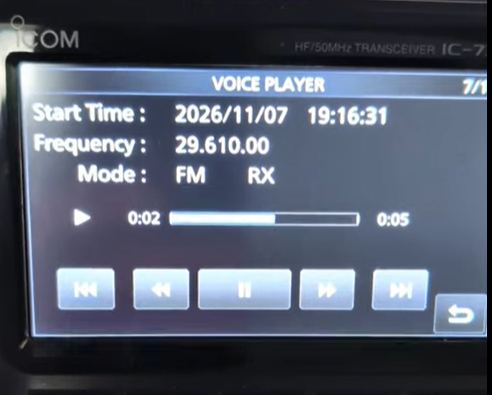
The other day a fellow ham told me there was some DX showing up on 29.6 FM. I tuned the IC-7300 over, left it on FM with the default settings, and heard it, but the DX faded out before I could work it. I stayed on frequency listening, and a while later NU5M came in, a station in Texas about halfway between San Antonio and Houston. I threw out my call and we had a solid, full-quieting QSO across roughly 1,500 miles. On FM!
If you work HF, you know why that’s a little wild. On SSB or CW you can dig a weak signal out of the mud, and digital modes will decode stuff you can barely hear. FM doesn’t play that game. Either the signal is strong enough to quiet the receiver or you get a earful of noise.
The antenna is what makes it funnier. I don’t have a 10-meter vertical or a beam. I was using my 80-meter end-fed half-wave, strung up as a sloper from about 15 feet up to roughly 70 feet in the trees. It’s not a 10-meter antenna by any stretch, but it’ll still load up there, and apparently it was happy to get a signal to Texas.
Most people on 10m FM are running verticals, and my wire is mostly horizontal. That mismatch would kill a normal line-of-sight VHF contact, but polarization gets shifted around on its way through the ionosphere, so it doesn’t matter nearly as much on HF.
As we signed off he mentioned he was running an IC-7300 on the seat of his car, so this was a 7300-to-7300 simplex contact across a good chunk of the country.
No amp, no beam, just barefoot radios and a wire cut for the low bands. That’s what I love about 10 meters when the cycle is alive. You never know who you might be able to work.
73,
Mike